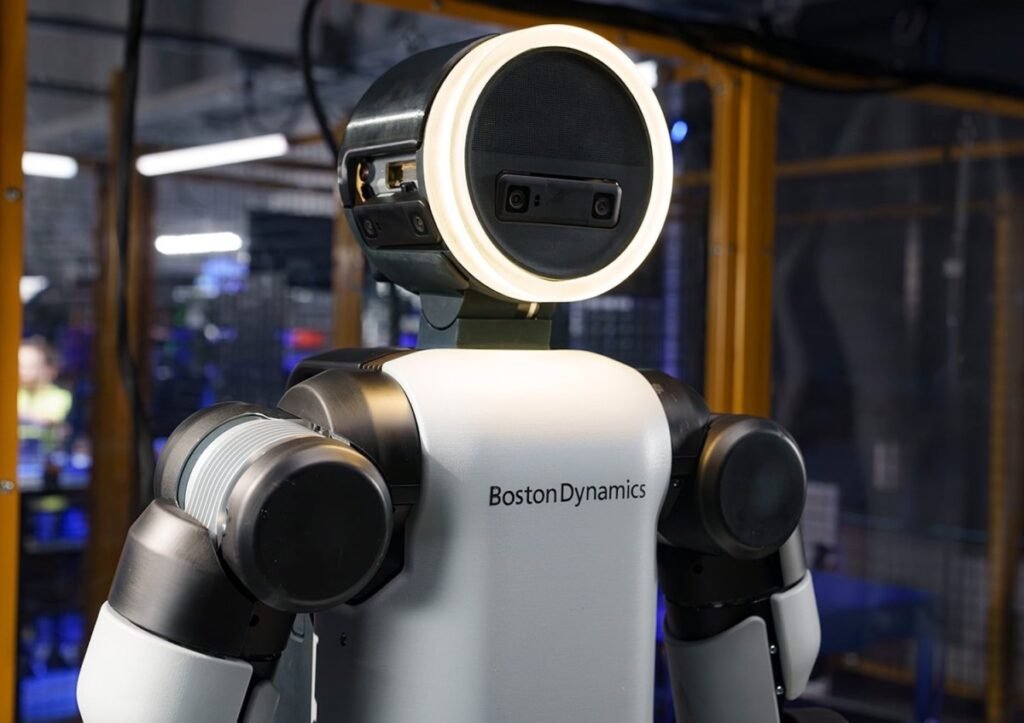
Boston Dynamics has unveiled its next-generation Atlas humanoid robot, integrating advanced Google DeepMind artificial intelligence to enhance machine learning and physical world interaction, with an initial deployment slated for Hyundai’s manufacturing facilities.
Engineering Power Meets Advanced Dexterity
The new Atlas model features 56 degrees of freedom, utilizing sophisticated rotation joints and human-scale hands equipped with tactile sensing. Engineered for industrial utility, the robot is capable of lifting up to 110 pounds and is specifically designed to execute repetitive, high-precision movements required in factory settings.
Integrating DeepMind for Adaptive Learning
Safety remains a primary focus, with hardware features like 360-degree cameras allowing the robot to detect human presence in real-time. However, the integration of DeepMind technology aims to move beyond predefined tasks. Instead of manual programming, the goal is for robots to perceive the physical world similarly to humans, learning from experience and generalizing across new scenarios.
“Rather than having a set of predefined, loaded tasks onto the robot, we think robots should understand the physical world the same way we do,” said Parada. “They should be able to learn from their experience, generalize new situations, and improve over time. Whether assembling a car part or performing delicate tasks, robots should learn from a handful of examples and refine their skills through practice.”
Hyundai’s Roadmap for Factory Deployment
Hyundai intends to integrate Atlas into its manufacturing pipeline starting this year, with a broader rollout for complex tasks like parts sequencing targeted for 2028. To support this transition, the company is launching the Robot Metaplant Application Center (RMAC) in the United States.
The RMAC facility will serve as a training ground where robots learn to map critical movements, such as lifting and turning. This internal training data will be synthesized with real-world operational data collected from Hyundai’s Georgia factory, creating a continuous feedback loop designed to optimize robot performance and safety protocols.