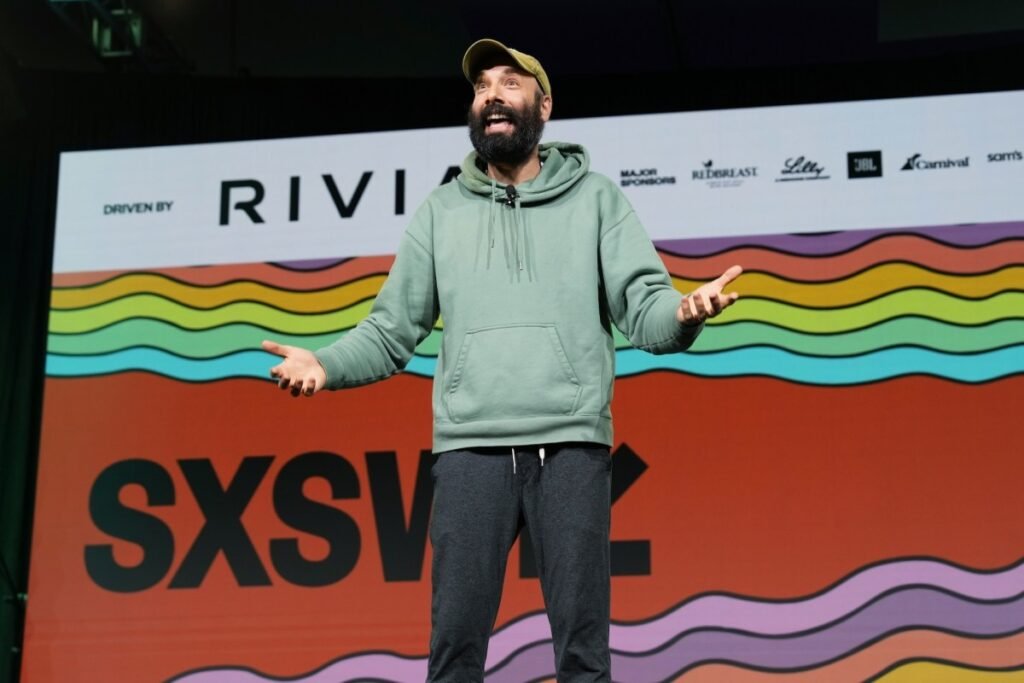
Patreon CEO Jack Conte slammed artificial intelligence companies at SXSW this week, labeling their “fair use” defense for training models on creator content as a “bogus” argument that ignores the rights of individual artists.
The Contradiction in AI Licensing
While Conte emphasized that he is not anti-tech—noting, “I run a frickin’ tech company”—he drew a sharp line regarding how AI firms treat intellectual property. During his keynote in Austin, the Patreon founder argued that if AI companies truly believed their practice of scraping data was protected under fair use, they would not be signing multimillion-dollar licensing deals with major media conglomerates.
“The AI companies are claiming fair use, but this argument is bogus,” Conte stated while reading from his manifesto. “It’s bogus because while they claim it’s fair to use the work of creators as training data, they do multimillion-dollar deals with rights holders and publishers like Disney, Condé Nast, Vox, and Warner Music.”
Questioning the Double Standard
Conte highlighted a glaring hypocrisy in the industry’s current trajectory. He posed a direct challenge to AI developers: “If it’s legal to just use it, why pay? Why pay them and not creators—not the millions of illustrators and musicians and writers—whose work has been consumed by these models to build hundreds of billions of dollars of value for these companies?”
By leveraging Patreon’s massive community of hundreds of thousands of creators, Conte is signaling that the platform intends to advocate for similar compensation models for independent artists, rather than allowing them to be sidelined by the AI boom.
Navigating the Cycle of Disruption
Conte framed the rise of generative AI as the latest iteration of disruption in the internet age. Comparing it to the industry-wide shifts from physical music sales to streaming, or the evolution of video formats on platforms like TikTok, he acknowledged that AI will inevitably break existing creative business models. However, he remains optimistic about the resilience of human creators.
“I learned a very important thing as an artist, which is that change does not mean death. You can get back up, and you can fucking go again,” said Conte, who originally founded Patreon to solve the persistent struggle of monetizing creative work.
Prioritizing Humanity in Future Tech
Ultimately, Conte argues that the integration of AI into society must prioritize the people who drive culture. He views the push for compensation not as an attempt to halt progress, but as a necessity for a healthy, creative society.
“I accept the inevitability of change, and I feel agency in discovering my next path through the chaos,” Conte explained. “The AI companies should pay creators for our work, not because the tech is bad—but because a lot of it is good, or it will be soon—and it’s going to be the future. And when we plan for humanity’s future, we should plan for society’s artists, too.”
Closing his talk, Conte reaffirmed his belief in the enduring value of human artistry. He noted that while large language models are designed to predict and replicate existing patterns, true innovation requires a different approach. “Great artists don’t play back what already exists,” he said. “They stand on the shoulders of giants. They push culture forward.”