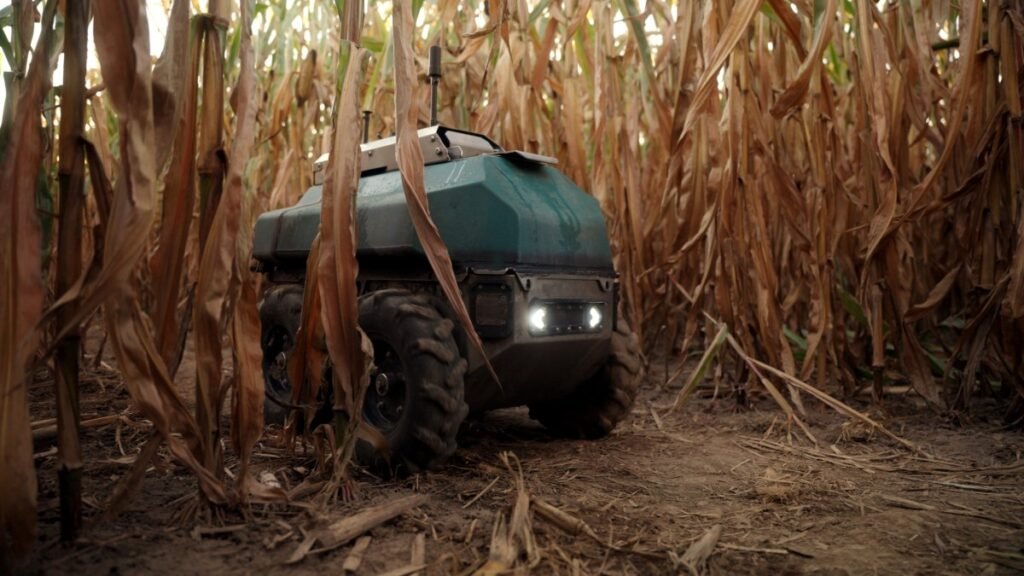
Upside Robotics is transforming corn farming by cutting fertilizer waste by 70%, a breakthrough that saves farmers approximately $150 per acre each season. Founders Dugan and Tian achieved this through intensive, hands-on field testing, scaling their operations from 70 acres in 2024 to a projected 3,000 acres for the 2026 season.
From Camper Vans to Field Innovation
The startup’s origin story is rooted in deep field immersion. “We actually bought a camper trailer, and we moved around field to field,” Dugan said. “We stayed on the side of the field every night, and we would be walking, sometimes around the clock. We have spent every hour of the day in a corn field at some point in time.”
To validate their concept, Dugan built a prototype robot in just two weeks. This remote-controlled device allowed the team to collect data manually, demonstrating the viability of their precision fertilizing system directly to farmers.
Rapid Iteration Through Direct Farmer Engagement
“We did our manual applications in year one, and that allowed us to iterate super fast, not just kind of on the hardware side, but learning by being with the farmers,” Tian said. “Some of our farmers said that we spent probably more time than they did in a lifetime in their fields. That allowed us to wrap up quickly. Neither of us were farmers, so that gave us firsthand experience into what it is like to basically be a farmer.”
After proving the concept throughout the 2024 season, the team spent the off-season refining their hardware. By 2025, they had successfully scaled their operation from 70 acres to 1,200 acres, maintaining a 100% customer retention rate.
Scaling Technology and Securing Future Growth
Upside Robotics recently secured a $7.5 million seed round led by Plural, with additional backing from Garage Capital and the founders of Clearpath Robotics. This capital injection is earmarked for research and development to address a backlog of over 200 farms on their waitlist.
The company is now setting its sights on international expansion, specifically targeting the U.S. corn belt.
Proven Demand for Sustainable Farming
“People always question if farmers are going to adopt new solutions, and they certainly are, and that’s something that we’ve learned firsthand, as long as you can provide them with a clear [return on investment] and a clear reason of why this technology was built,” Tian said. “In our case, it wasn’t something that we actually had to sell to farmers. In a lot of cases, our farmers actually asked for this solution.”