Colin Angle, co-founder of iRobot, reveals the immense internal toll of the failed Amazon acquisition, describing an 18-month regulatory ordeal that forced the company to produce over 100,000 documents while facing what he characterizes as a hostile FTC. Speaking candidly about the collapse of the multi-billion dollar merger, Angle details how the process felt less like a fair review and more like a systematic effort to stifle the innovation economy.
The “Trophy” Culture at the FTC
The amount of money and time spent was indescribable. I would not be surprised if over 100,000 documents were created and delivered. iRobot invested a significant part of our discretionary earnings against fulfilling the requirements that went along with doing the transaction. Amazon was forced to invest many, many, many times that. There was a whole team, both internal and external employees and lawyers and economists working to try to, in as many different ways as possible — because it seemed like our message was falling on deaf ears — demonstrate that this acquisition was not going to create a monopolistic situation.
There was daily activity for 18 months associated with this. Perhaps most telling, when I was testifying as part of being deposed, I had a chance to walk the halls of the FTC. The examiners on their office doors had printouts of deals blocked, like trophies.
To me, it felt so wrong as an entrepreneur who started this thing literally in my living room and lived six and a half years never having enough money in the bank to make payroll, finally making it through succeeding. Here’s an agency whose stated mission is protecting consumer interests and helping the United States economy, celebrating as victories every time they shut down M&A, which in a very real way is the primary driver of value creation for the innovation economy.
I went into this deposition looking for a friend. It’s like, “Here we are, we’re obviously not in a stronger place, and here’s a great opportunity for us. Are you excited for us?” Maybe this is just my naïve take coming out, but that’s not the reception I got. It was, “Why should we ever let them do this?” It’s like: because it’s good for the consumer — because it’s going to catalyze innovation.
The Chilling Effect on Future Startups
Risk has a chilling effect. If you’re an entrepreneur, your only option is to hope that it doesn’t happen again. The reason you and I are talking is I hope by my words I can make it less likely that it will happen again.
I founded a new company and my outlook on exit strategy and even commercialization strategy is impacted by the experiences I had at iRobot. How can it not be? That precedent creates risk of it happening again, and only through positive experiences do we start to dial down the anxiety that the exits I’m depending on — or as a venture capitalist, the exits I’m investing in assuming will happen — will actually come through. That risk is factored into the willingness to invest, the valuation of deals, and the rate of new company formation.
It’s hard to say there’s X percent fewer entrepreneurial starts or exits as a result of the chilling message, but it certainly didn’t help. Entrepreneurs can use every leg up that we as a nation can provide. It is a rugged journey. When it actually works out, it should be a celebration. The FTC is there as a safeguard against very real examples of things gone too far. I’m a big believer in checks and balances. But when things get out of whack, the country suffers.
From Academic Labs to Global Impact
iRobot was a bunch of people in an academic lab saying, “We were promised robots. Where are the robots?” If I could be pissed off that I don’t have the robots we were promised, I should do something about it. If not us, who? If not now, when?
One of the co-founders, my professor Rod Brooks, had pioneered an AI technology which allowed the embedding of machine intelligence in low-cost robotics. The mission of the company was to build cool stuff, deliver a great product, have fun, make money, and change the world.
The first business plan was “private mission to the moon, sell the movie rights.” We were maybe the first company to fail to do exactly that. But the technology we developed led to additions to the Mars Pathfinder mission — my name’s up on Mars. We built robots that went into the Gulf of Mexico after the Deepwater Horizon disaster. We built the PackBot, which was the first robot ever deployed in a combat mission for the U.S. Army, went into caves in Afghanistan, and became the primary methodology for defusing improvised explosive devices. We would get postcards: “You saved my life today.”
When the Fukushima disaster happened, we donated half a million dollars’ worth of robots to Japan. We sent six people over to train Tokyo Electric Power Company employees. Those robots were the first inside the reactor doors, mapped out radiation levels, and found a path where an employee could run in, get to the control room, work for a minute and a half, run back out, and only receive a lifetime dose of radiation. We were credited with enabling the shutdown of the reactor.
The Roomba Breakthrough and Marketing Lessons
I had a team that was working on toys, and one of the guys said, “Colin, I think it’s time we can do this. We can finally make the vacuum.” I’m like, “Okay, here’s $15,000. Two weeks. See what you can do.” Two weeks later they came back and said, “Hey, that’s not bad. Maybe there’s something here.” We scraped and found a little bit of money [to build these]. A year and a half later, I convinced my board that we could build 10,000 of these robots and we launched them.
It’s really the media that picked up the story. We had no money for marketing. Reporters were fascinated because we tended to do interesting things that were real, and they couldn’t believe that robot vacuuming could possibly be real. [The reaction was:] “My God, it actually worked.” We ended up selling 70,000 robots in the first three months. Then we nearly went out of business the next year.
Because we screwed up. The press drove this huge initial demand — 70,000 robots. So next year we’re going to do four times that. We made 300,000 robots. We even made a television commercial, but we were a bunch of geek engineers, so it totally failed. After Cyber Monday we were sitting with 250,000 robots in our warehouse like, “Oh my God, the world’s going to end.”
Then something good happened. The guy running our website said, “Why did sales quadruple yesterday?” We hadn’t done anything. What had happened was Pepsi had started running a TV ad with Dave Chappelle. He walks into this beautiful home, picks up a potato chip, and a Roomba comes out. He’s like, “A vacuum cleaner!” He throws down the potato chip, the vacuum eats it, then chases him. His pants are ripped off. He stands up in boxers. A beautiful woman appears, and he says, “Your vacuum cleaner ate my pants.” We sold 250,000 robots in two weeks and realized we knew nothing about marketing.
No idea. It was wild. You try to do good for so long and you get smacked in the face so many times, and then sometimes something good happens. You could say because of that crazy moment in time, we have robots. When we think about just how fragile a journey it is — cats riding Roombas was a big part of why we succeeded. Does that make any sense? No, not at all. But we certainly didn’t expect tens of billions of views of cats riding Roombas.
Strategy and the Future of Robotics
We explicitly did not put lasers on the robot. We had the technology decades ago because it’s a dead-end technology. Under my strategic direction, we were going to invest every penny of cost against a vision-based nav and situational understanding system. Your Tesla does not have a laser on it. It is all vision-based. At least Elon agrees with me.
Our strategic plan was for Roomba to be much more than just a vacuum cleaner in the home. To do that, it needs to understand more. Lasers are not advanced technology — they’ve been around for decades. They’re an expedient solution to a subset of the problems that a robot at home needs to take on. A laser will never tell you whether you actually cleaned the floor or not.
It is absolutely true that Chinese competition was coming in at lower price points. We were late in building a two-in-one robot — we believed that by separating mopping and vacuuming you could give a better customer experience. The customer voted that we were wrong, and that’s okay. We certainly were first in auto-evac, first in navigation. We were also importantly excluded from the Chinese marketplace, which is the largest market for consumer robotics in the world. That didn’t help.
The first thing I tell all robotics entrepreneurs is: make sure you understand your market so that you are building something that delivers more value than it costs to create. Robots are so exciting, so sexy that it’s really easy to convince yourself that you’re doing something that is going to change the world, if only consumers were smart enough to realize it. That’s a pretty tough equation.
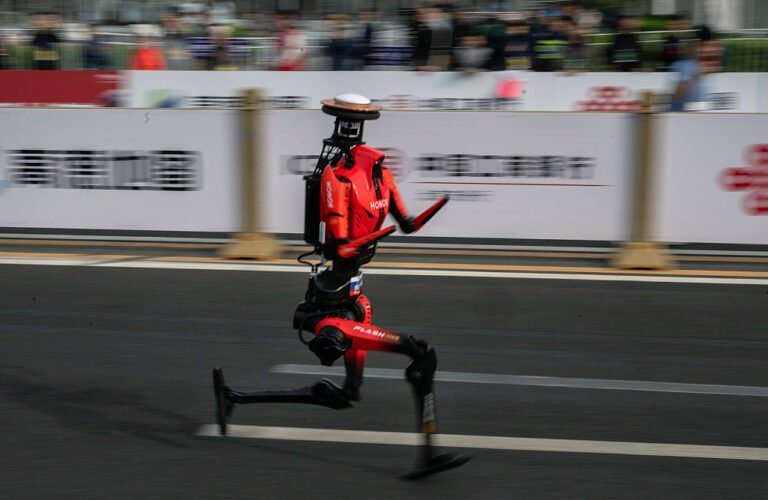
Technology is oftentimes in the robot space well ahead of the business plans that can take advantage of the technology. One of the traps is thinking of robotics as a thing as opposed to a toolkit. As soon as you say, “I’m going to build a robot,” and head off building your humanoid — are you really doing it because you understand a problem you’re trying to solve, or are you enamored with building your thing?
When I started iRobot, it was just assumed that robots were going to vacuum floors by building humanoids to push upright vacuum cleaners. When we first built Roomba, we would ask people, “Is that a robot?” People would say, “No, that’s not a robot. A robot has arms and legs and a head.” Yet Roomba at the time cost 10,000 times less than a humanoid pushing an upright vacuum.
The challenge of entrepreneurship is breaking through the romance and opportunity and falling in love with your technology and getting to the application that you’re trying to solve. Understand your consumer, understand the problem you’re trying to solve — because it’s complicated, robotics is expensive, and it takes a lot of energy to get right.
We’re in stealth mode, but I’ll give you a broad hint. It’s consumer-facing. We’re really looking at the fact that most of the things robots can do to meet outstanding needs require us to interact with other people. So how do we build a robot that actually has sufficient emotional sophistication — not human-level, but enough — to build an enduring co-character that can make sense over time and use that for health- and wellness-related applications?
It’s going to be awesome. I’m so excited about it. It’s given me enthusiasm and energy to have a chance to use this new toolkit and continue on my journey to build the robots we were promised. I really haven’t changed that much from a grad student in college saying, “Oh my God, we’ve been promised robots and we don’t have the ones that I want yet.” I spent 30 years focused on building the world’s greatest floor care robot, and now I have a chance to do something else.