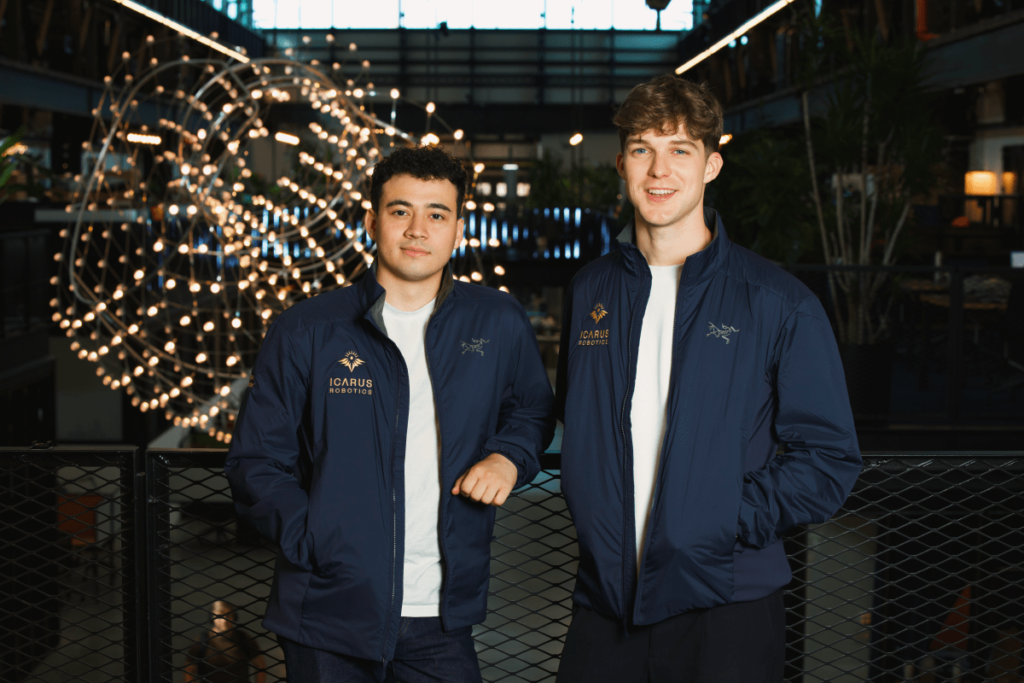
Icarus has raised $6.1 million to deploy embodied-AI robots designed to handle repetitive “warehouse-style” tasks on the International Space Station (ISS), such as swapping cartridges and managing cargo.
Mastering Microgravity Dexterity
The startup recently showcased its capabilities through a terrestrial long-distance teleoperation demo. Using a bimanual jaw gripper system, the team successfully unzipped, unpacked, and resealed an actual ISS cargo bag. “We were able to demonstrate that you don’t need to go the whole way to hands to get meaningful dexterity at a long distance,” said Palmer.
The Road to Orbit: Testing and Deployment
The company is now shifting its focus toward flight testing. Icarus plans to launch a parabolic-flight campaign early next year, followed by a one-year demonstration on the ISS in partnership with Voyager Space, the operator of the commercial Bishop airlock. This mission aims to de-risk cargo operations before transitioning to more complex maintenance tasks, such as filter and seal inspections.
The Economics of Teleoperation
Initially, these robots will rely on human teleoperation. Palmer notes that the ISS is a unique environment where the high cost of human labor justifies having a dedicated operator “behind the wheel” of the machine at all times. “The labor arbitrage margin is so big” that employing a skilled robotic operator for a year is economically viable, he explained.
Scaling Toward Embodied AI
Icarus’ long-term vision involves building general-purpose autonomy through “embodied AI.” By collecting microgravity data with humans in the loop, the company intends to create foundational models for orbital robotics. This approach mirrors current terrestrial robotics trends but is specifically tuned for the unique physics of microgravity.
From Partial Autonomy to Deep Space
The roadmap includes a transition to partial autonomy, where operators trigger “higher-level primitives”—simplified, intelligent commands like “open the bag” or “unstow the items.” Ultimately, the goal is to achieve full autonomy for deep space missions where real-time teleoperation is impossible due to signal latency.
Augmenting Human Potential
“We don’t want to remove the astronauts,” said Barajas, who brings extensive space experience starting from his first NASA internship at age 17. “We want to augment them. We want to make the short time that they have on station as profitable and as research-heavy as possible.”