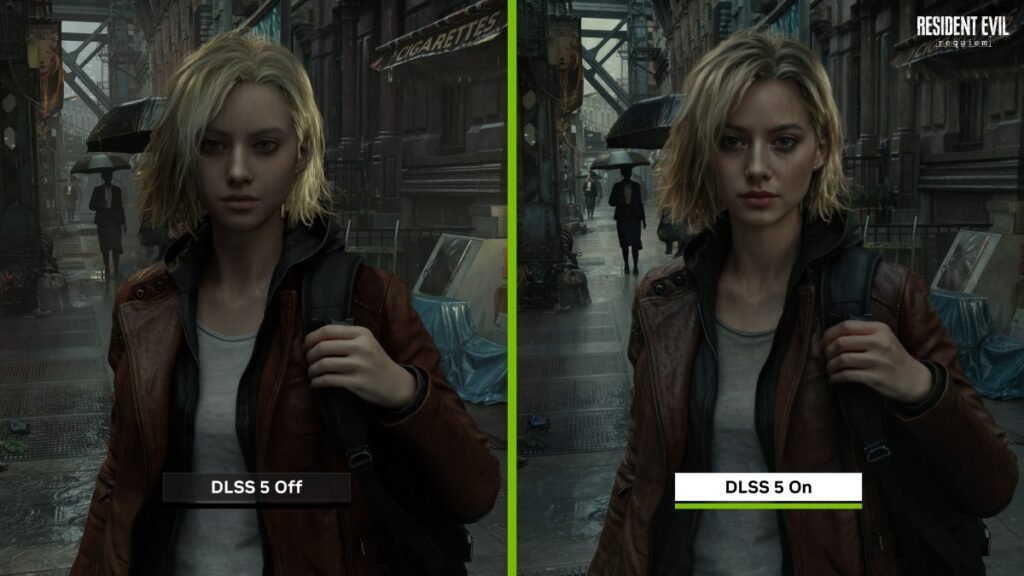
Nvidia is pushing the boundaries of real-time rendering with DLSS 5, a new iteration of its deep learning super sampling technology that leverages generative AI to drastically enhance photorealism in video games while setting the stage for applications far beyond the gaming industry.
The Evolution of AI-Driven Rendering
The core philosophy behind this technological leap was recently highlighted by Nvidia CEO Jensen Huang. During a recent presentation, he emphasized the shifting paradigm of data interaction, noting that the future of computing will rely heavily on AI’s ability to process information at speeds unattainable by human developers.
“In the future, what’s going to happen is these data structures are going to be used by AI, and AI is going to be much, much faster than us,” Huang said. By integrating generative AI directly into the rendering pipeline, Nvidia is not just upscaling frames; it is effectively reconstructing visual data to mirror the complexity of the physical world.
Beyond Gaming: A Generative Future
While gamers will immediately benefit from higher frame rates and more lifelike lighting, textures, and shadows, the implications of DLSS 5 extend into broader digital realms. The transition from static, manually structured data to dynamic, generative databases is central to this expansion.
“Future agents are going to use structured databases as well as the unstructured database, the generative database. This database represents the vast majority of the world,” Huang explained. This shift suggests that the same AI models currently perfecting virtual environments could soon be utilized to power complex simulations, digital twins, and autonomous agents that require an intuitive understanding of unstructured, real-world data.