Rivian CEO RJ Scaringe has launched a new robotics venture, Mind, challenging the current industry obsession with humanoid robots that mimic human biomechanics, arguing instead for a design philosophy centered on hand dexterity and industrial efficiency.
The Genesis of Mind: Beyond Rivian
Mind, a company spun out of Rivian, is Scaringe’s answer to the future of manufacturing. Born from the need to scale Rivian’s R2 production, Scaringe realized that relying on existing industrial robotics—or current humanoid startups—was insufficient for the complex, multi-billion dollar factory needs of the coming decade.
“I kicked off an effort to study the future of manufacturing, and essentially came to the view that while classic industrial robotics will persist, the idea of robotics with human-like skills is going to be vital,” Scaringe explains. He notes that most startups currently focus on household tasks like folding laundry, leaving a gap in specialized industrial applications.
Why “Project Synapse” Matters
Originally dubbed “Project Synapse,” the company was named after the brain’s neural connections and a school Scaringe’s children attended. While the internal project name was a nod to those roots, the final branding, Mind, reflects a simpler, more direct vision for the company’s future.
Scaringe is currently supported by a board that includes Jiten Behl of Eclipse and Sameer of Accel. By keeping Mind as a private entity, he believes the company can maintain a more agile structure than a public corporation, allowing for faster development cycles.
Rethinking the Humanoid Form Factor
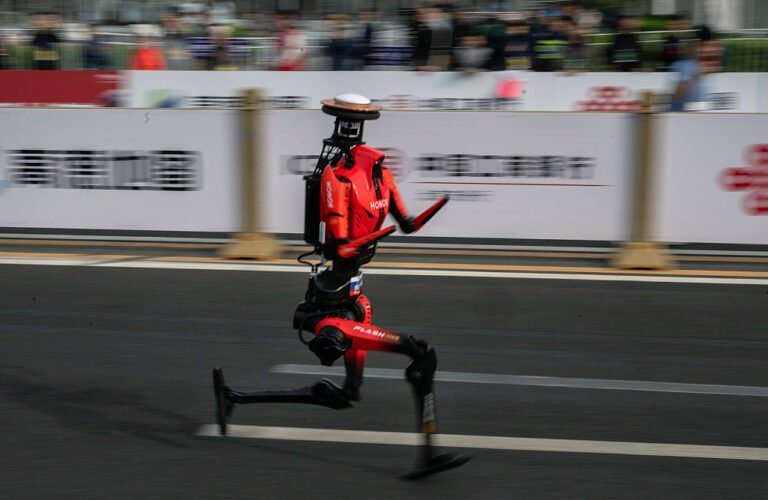
A central point of contention for Scaringe is the industry’s focus on “athletic” robots capable of feats like backflips. He argues this introduces unnecessary complexity and failure points. “If you were to go into a Rivian facility, you will see very few people that have the type of flexibility that would enable them to do a backflip,” he says.
For Scaringe, the focus should be on the hands. Manufacturing is inherently task-based, and human-like biomechanics for the entire body are often counterproductive. “Everything else, from a robotic system point of view, is to get the hands to the right place,” he asserts, emphasizing that the torque and dexterity required for threading a fastener are vastly different from gripping heavy steel pipes.
Industrial Design: Friendly, Not “Dopey”
Scaringe also criticizes the “Terminator-like” aesthetic common in modern robotics. He believes robots working alongside humans in a factory setting need a different design language—one that is approachable and friendly without appearing cartoonish or “dopey.”
“If you were to ask somebody in 2018 what a 1,000 horsepower truck looks like, and you squinted, you wouldn’t think of an R1,” Scaringe notes, drawing a parallel to his design philosophy at Rivian. He intends to bring that same aesthetic—capability without intimidation—to the world of robotics, ensuring that machines are not only functional but well-integrated into the human-centric environment of a manufacturing plant.