
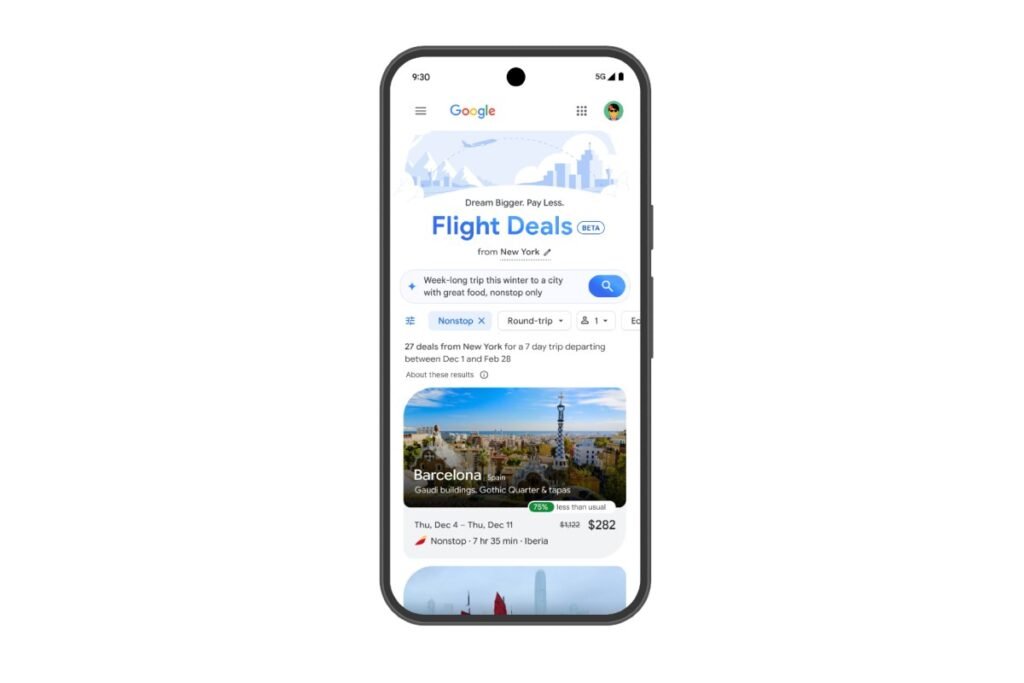
Google launched a new AI-powered search feature called Flight Deals on Thursday, designed to help travelers discover budget-friendly fares through natural language queries, even as the company faces intensifying global antitrust pressure regarding its dominance in travel discovery.
How Google’s New AI Flight Tool Works
Integrated directly into Google Flights, the tool allows “flexible travelers” to input descriptive requests rather than traditional search parameters. Users can type specific travel goals, such as “week-long trip this winter to a city with great food, nonstop only” or “10-day ski trip to a world-class resort with fresh powder,” and the AI generates matching itinerary options.
Google confirmed that Flight Deals is powered by a custom version of Gemini 2.5. While the tool utilizes AI to parse language and identify destinations, the underlying pricing data is pulled from real-time feeds provided by airlines and travel partners. The results are ranked primarily by the percentage of savings, with secondary sorting based on the lowest absolute price for deals where savings percentages are equal.
Navigating Antitrust Pressures
The rollout arrives at a sensitive time for the tech giant. Regulators, most notably the European Commission, are actively investigating whether Google unfairly favors its own products—such as Google Flights—to the detriment of market competition. Under the Digital Markets Act, EU officials are scrutinizing the company’s influence, leading to reports that Google may soon propose adding a price-comparison box to search results to appease authorities.
Beta Rollout and Privacy Controls
Initially available in beta, the tool is slated for release in the U.S., Canada, and India over the coming week. Google stated the beta phase is focused on gathering user feedback to refine AI-driven travel planning. Regarding data privacy, the company confirmed that user queries are treated as search history, and individuals retain the ability to manage or delete this data through the “MyActivity” portal.
The Competitive Landscape
This integration represents a strategic push to keep pace with rivals like OpenAI, Anthropic, and Perplexity. While Google is entering the AI travel space slightly later than competitors such as Booking.com, Expedia, and Indian aggregator MakeMyTrip, its massive scale could still disrupt the market if the tool gains widespread adoption.
Despite this new addition, the classic Google Flights interface remains intact. The original search tool, which debuted in 2011, is also receiving its own updates, including a new feature that allows users to filter out basic economy fares for travel within the U.S. and Canada.