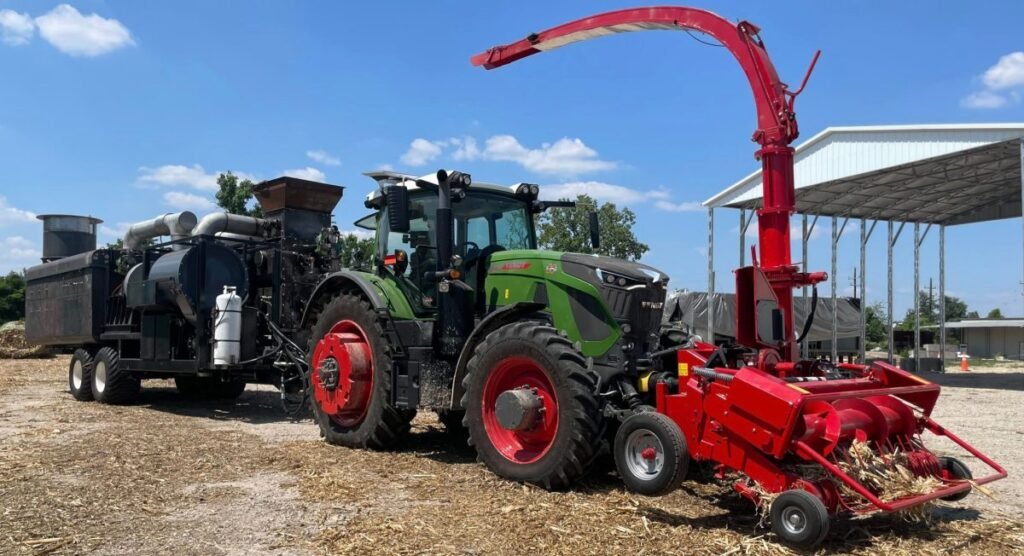
Applied Carbon has developed a novel tractor-pulled machine that transforms agricultural crop residue into biochar directly in the field, creating a scalable method to sequester CO2. By processing plant waste on-site, the startup aims to simplify carbon removal logistics while providing farmers with a valuable soil amendment.
Emulating Industrial Efficiency
“The ag industry has evolved over more than a century to build these big kind of grazers that drive through a field and harvest material,” said CEO Aramburu. “It just kind of dawned on me, the best way to do anything with ag residue was to emulate that model of operation.”
The Steampunk-Inspired Carbon Processor
The machine functions like a mobile industrial plant. Pulled by a tractor and fed by a harvester, crop residue is deposited into a hopper and chopped. The material is then dried using recycled hot gas from the internal pyrolysis reactor. Inside the pyrolyzer, the waste is converted into biochar and syngas, the latter of which powers the machine’s operations. Finally, the biochar is quenched with water and integrated into the soil via a disc harrow, completing the sequestration cycle.
Despite its technical sophistication, Aramburu notes that the implement streamlines biochar production logistics, resulting in lower costs and more accurate carbon accounting compared to centralized processing models.
Scalability and Crop Versatility
Over its four-year history, Applied Carbon has developed five prototypes. While the current model is optimized for corn residue, the technology is adaptable to various crops, including wheat, rice, sorghum, sugarcane, and straw. The system currently covers approximately one acre per hour when paired with a heavy tractor, with ongoing efforts focused on increasing operational speed.
Fueling Production with $21.5 Million
A recent $21.5 million Series A funding round is set to transition the company from prototyping to early-stage production. “We raised this funding really to go from prototype to early production of our pyrolyzer,” Aramburu explained. The company is currently manufacturing units in Houston, with deployment planned for Texas, Oklahoma, Arkansas, and Louisiana. The biochar produced in these regions will serve as carbon offsets for clients, including Microsoft.
From Fleet Operator to Equipment Manufacturer
While the startup currently manages the tractor operations itself, the long-term business model involves leasing or selling equipment directly to farmers. This strategy includes assisting farmers in monetizing the carbon credits generated by their land.
“To get to gigaton scale, we would need thousands of tractor operators in the field doing this, and that’s just not really scalable,” Aramburu said. “We don’t want to be a fleet. We want to be more like a John Deere.”
Strategic Backing
The Series A round was led by TO VC. Additional participants included Anglo American, Autodesk Foundation, Congruent Ventures, Elemental Excelerator, the Grantham Foundation, Microsoft Climate Innovation Fund, Overture.vc, S2G Ventures, Susquehanna Foundation, Telus Pollinator Fund for Good, the U.S. Endowment for Forestry and Communities, and Wireframe Ventures.